Written by
Federer Foundation
15 April 2026
The integration of the Smart Tablet Early Learning Assessment (STELA) tool into pre-service teacher training – the training teachers receive before entering the workforce – marks a significant moment, a deepening of what has already proven to work.
STELA was developed in 2019 as part of the School Readiness Initiative, in close collaboration with the University of Zimbabwe and with support from the Ministry of Primary and Secondary Education. Designed by local early childhood development experts and shaped by teachers and parents from rural, farm and urban communities, the tool helps early childhood development (ECD) teachers monitor whether children are developmentally on track and ready for Grade 1. Since then, STELA has been rolled out through in-service training, reaching more than 1,100 primary schools and gaining strong endorsement from teachers, head teachers and education officers.
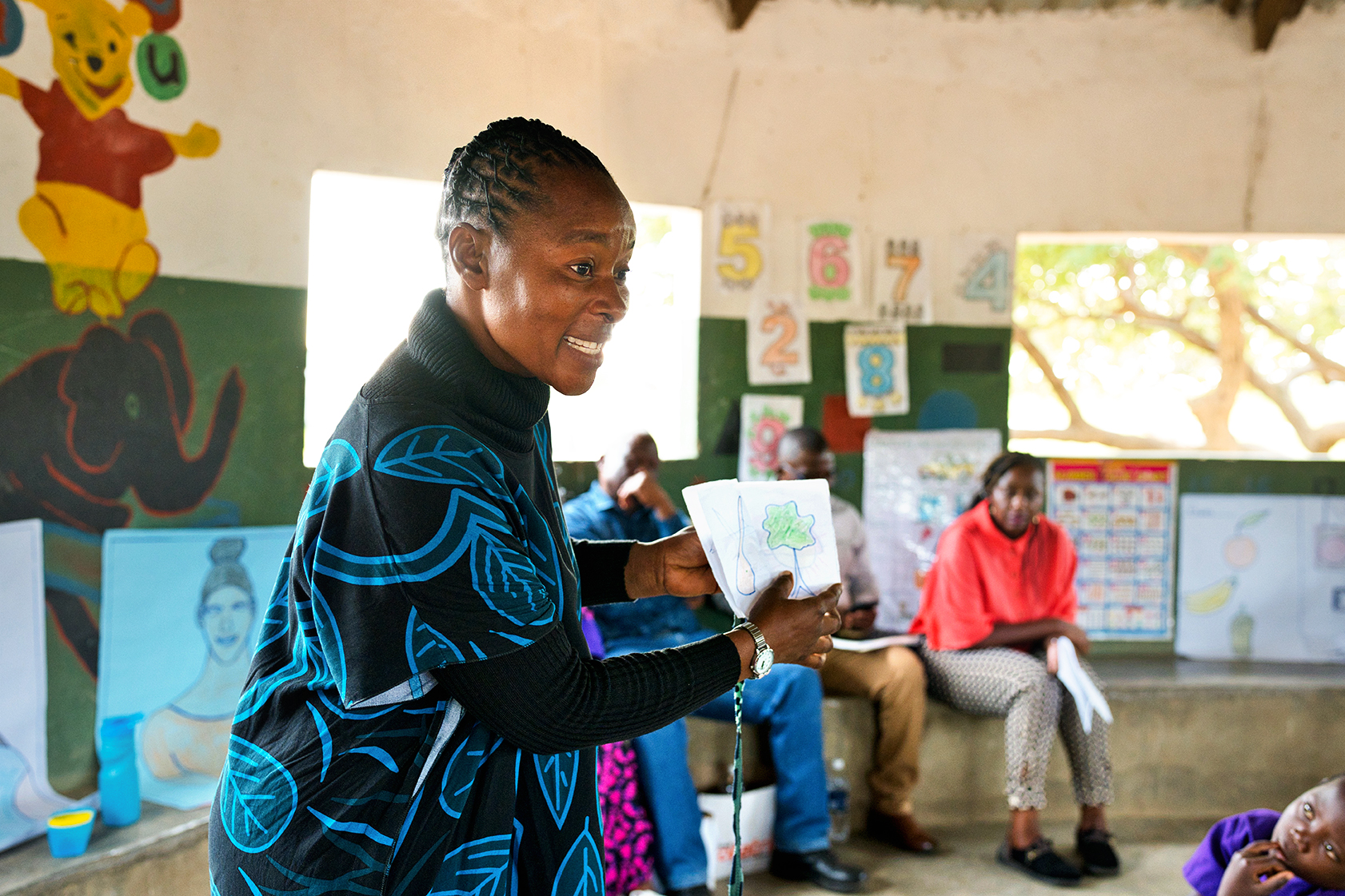
Ms Chakaraya with her preschool class in Zvimba District, Mashonaland West, Zimbabwe © edt
And this was not a straightforward process; the path was filled with many learnings along the way. Early implementation showed that while teachers valued STELA, uptake varied depending on the quality of training, confidence with technology, and the level of institutional support available. Reaching scale through in-service delivery alone proved resource-intensive and difficult to sustain. These realities sharpened our focus on system-level integration as the most viable path to long-term impact.
What we learned early on was clear: tools alone, even the most innovative, do not drive change. Impact accelerates when practical advancements are embedded in systems, owned by institutions, and aligned with national priorities. In Zimbabwe, STELA’s focus on school readiness, data-informed teaching and appropriate use of technology resonated strongly with government ambitions around education quality and innovation. This alignment was formally recognised in 2023, when STELA received a national award for innovation at the Presidential Innovation Fair.
Building on this momentum, 2025 marked a new phase. STELA has now been integrated into the pre-service teacher education programmes of all 14 teacher training colleges in the country. Three new modules, grounded in the School Readiness Initiative, are being mainstreamed into the national syllabus, ensuring that future early childhood development teachers graduate with the skills, mindsets and tools needed to support children’s early learning from day one. STELA also extends to Work Integrated Learning, meaning that that teachers in training can practically use and engage with the assessment tool and methods in the classroom.
This shift from project-based approaches to system-level integration is one of the most important takeaways shaping our next strategy. By working across ministries, teacher training institutions and universities, Zimbabwe has shown how sustained partnerships can secure long-term impact and reduce reliance on external programmes. Each year, more than 3,000 newly trained ECD teachers will now enter classrooms already familiar with STELA and contemporary approaches to school readiness – reaching thousands more children than any single initiative could on its own.
We have also learned that adapting the solutions to the context is crucial. STELA’s development and adoption have gone hand in hand with a focus on culturally relevant, locally produced learning and play materials. This reinforces relevance for children and teachers, while supporting sustainability and local innovation within the education system.
As we look ahead, Zimbabwe offers a powerful example of how evidence, trust and patience can drive policy change. It reinforces our belief that lasting impact happens when we evolve alongside systems – strengthening what works, listening closely, and investing for the long term. This learning is a vital part of our new strategy, as we continue to focus on deeper, more sustainable impact for young children.